

 Dr. Ahmed Farhan
Medical Disclaimer: This article is for educational and informational purposes only and does not constitute individual medical advice, diagnosis, or clinical treatment. Always consult your personal physician or qualified healthcare provider regarding medical conditions, prescription changes, or new health regimens.
Transparency Disclosure: Dibesity features independent, evidence-based medical research. Some articles may contain vetted affiliate links to metabolic wellness products; if you make a purchase, we may earn a modest commission at no extra cost to you.
Wegovy (semaglutide 2.4 mg, once weekly) produces substantial weight loss and is one of the best-studied obesity medicines.
However, it is not the most effective option in every comparison. A head-to-head meta-analysis found that tirzepatide produced greater weight loss than semaglutide, and a combination of cagrilintide and semaglutide (CagriSema) outperformed semaglutide 2.4 mg in pooled trials.
Wegovy has also been linked to clear gastrointestinal side effects and a higher rate of stopping treatment. The right drug depends on the benefit–risk balance for each person, so the decision should be made with a clinician.
What Is Wegovy?
Wegovy is the brand name of injectable semaglutide at a dose of up to 2.4 mg once weekly. It is used for chronic weight management. Semaglutide is a glucagon-like peptide-1 (GLP-1) receptor agonist. Wegovy is not itself a drug class.
Semaglutide is sold in other forms for other purposes:
- Ozempic: a once-weekly injection at lower doses, mainly indicated for type 2 diabetes.
- Rybelsus: a once-daily oral tablet, mainly indicated for type 2 diabetes.
Semaglutide has a half-life of about one week, which is why it is dosed weekly. Current labeling, including the approved populations (for example, adolescents, or cardiovascular risk reduction), should be verified directly against the official prescribing information.
The term “diabesity” is informal. It describes obesity and type 2 diabetes occurring together. Because GLP-1 receptor agonists lower both body weight and blood glucose, they are often discussed for this group. Which products are approved for which indication should be confirmed on current labels.
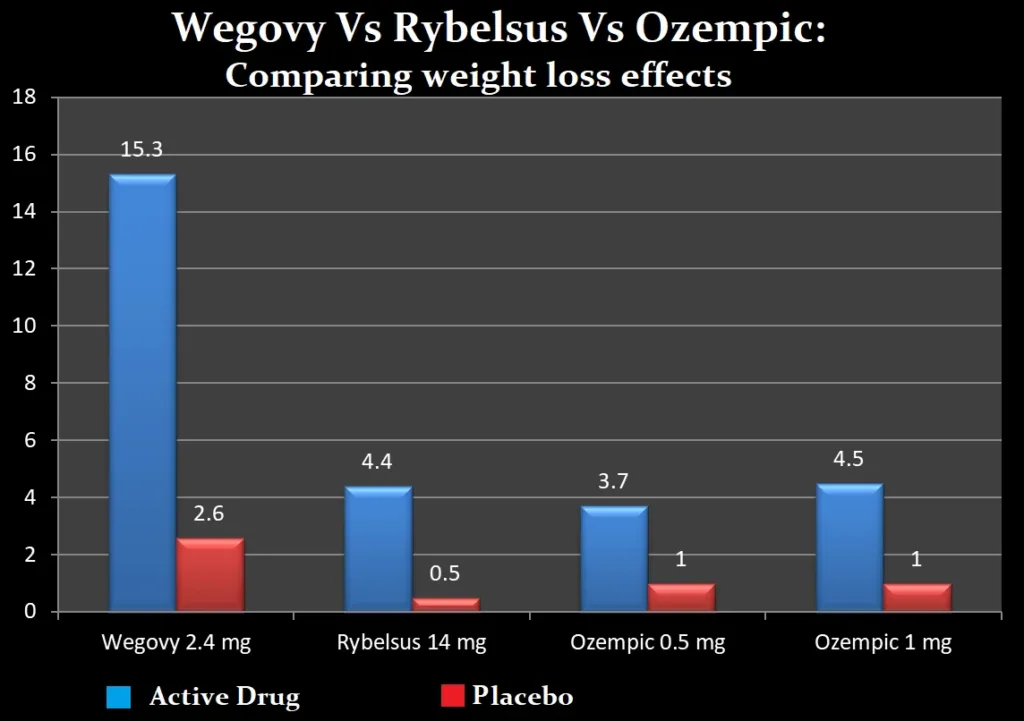
How Much Weight Do Different Drugs Cause People to Lose?
Percentages from separate trials cannot be compared directly. The trials differ in population, duration, dose, background lifestyle support, and how results are analysed.
Network meta-analyses try to reduce this problem by combining many trials statistically. This remains indirect evidence for most pairs of drugs.
A large BMJ network meta-analysis covered 262 randomised trials and 99,791 participants. It reported one-year weight change compared with lifestyle modification alone, as shown below (PMID 42419792).
| Drug (as reported in the analysis) | Mean weight change vs lifestyle alone at ~1 year (95% CI) |
|---|---|
| Tirzepatide | −14.9% (−16.0 to −13.9) |
| Cagrilintide-semaglutide (CagriSema) | −14.8% (−16.9 to −12.7) |
| Oral semaglutide | −10.9% (−12.7 to −9.1) |
| Orforglipron | −9.9% (−12.4 to −7.5) |
| Subcutaneous semaglutide | −9.8% (−10.6 to −9.1) |
| Phentermine-topiramate | −8.1% (−9.7 to −6.5) |
These figures were rated moderate to high certainty. They are pooled estimates, so they are lower than the headline figures from individual semaglutide 2.4 mg trials, such as the roughly 15–16% reported in the STEP trials.
Those trial-specific figures were not among the studies supplied for this draft and should be verified against the original publications.
The 16% figure also came from a trial with intensive behavioral therapy, so it should not be treated as a general expectation for Wegovy.
For the other older agents, the original article quoted trial results that cannot be verified from the supplied evidence, so they are not repeated here.
One analysis of liraglutide 3.0 mg, semaglutide and tirzepatide ranked liraglutide 3.0 mg as giving the smallest weight loss of the three (PMID 42560457).
Wegovy Compared With Individual Drugs
Tirzepatide (Mounjaro, Zepbound)
A systematic review and meta-analysis of head-to-head studies included 10 studies and 41,381 participants. Tirzepatide produced greater weight loss than semaglutide (mean difference −4.28 percentage points; 95% CI −5.28 to −3.28) and a greater HbA1c reduction (−0.29%).
It also produced more patients reaching 10%, 15% and 20% weight-loss thresholds. Discontinuation due to adverse events did not differ significantly, but serious adverse events were more frequent with tirzepatide (RR 1.83) (PMID 42670242).
Observational studies were included in that analysis, so it is not purely randomised evidence. For more detail, see Dibesity’s pages on tirzepatide and tirzepatide versus semaglutide.
Higher-dose semaglutide (7.2 mg)
A network meta-analysis of 23 phase 3 trials ranked semaglutide 7.2 mg above 2.4 mg for efficacy, but the average added benefit was modest (about 2–3 percentage points).
A significant advantage in percentage weight change was found only in the diabetes subgroup. Tirzepatide 15 mg ranked highest for weight and waist reduction.
The authors advise balancing the extra benefit against tolerability and patient preference (PMID 42560457).
Whether and where the 7.2 mg dose is approved should be verified, and the higher-dose discussion should not be read as a dosing recommendation.
Liraglutide (Saxenda, Victoza)
Liraglutide is also a GLP-1 receptor agonist. Saxenda is the higher-dose product for chronic weight management, and Victoza is used for type 2 diabetes.
In the network meta-analysis above, liraglutide 3.0 mg gave the smallest weight loss of the three GLP-1–based agents and was linked to higher risks of any adverse event and of discontinuation due to adverse events (PMID 42560457).
The original claim that liraglutide was the only drug approved for “diabesity” is not verified and has been removed.
Orlistat, phentermine-topiramate and naltrexone-bupropion
- Orlistat (Xenical, and lower-dose over-the-counter Alli) reduces the absorption of dietary fat by inhibiting gut lipases.
- Phentermine-topiramate extended-release (Qsymia) combines an appetite-suppressing stimulant with an anticonvulsant. Its pooled one-year effect was about −8.1% vs lifestyle alone in the table above (PMID 42419792). See also topiramate for weight loss.
- Naltrexone-bupropion (Contrave) combines an opioid-receptor antagonist with an antidepressant. In the BMJ analysis it was among the agents with the highest discontinuation due to adverse events and gastrointestinal events, and it showed a marked increase in fatigue (RR 8.9) (PMID 42419792).
Lorcaserin (Belviq)
Lorcaserin, a serotonin-receptor agonist, was withdrawn from the US market after a regulatory safety review raised a cancer signal.
The specific details and date should be confirmed against official FDA communications, since they are not part of the supplied evidence. It is no longer a current option in that market.
CagriSema and retatrutide
CagriSema is a fixed-dose combination of cagrilintide and semaglutide. A meta-analysis of five trials (4,746 participants) found greater weight loss than semaglutide 2.4 mg (mean difference −6.89 percentage points; 95% CI −8.70 to −5.06).
It also found about twice the likelihood of reaching a 20% reduction. Injection-site reactions were more frequent (RR 3.14), and gastrointestinal events were not significantly increased in the primary model.
The authors note that evidence is insufficient on serious adverse events, long-term durability, cardiovascular outcomes and body composition (PMID 42890523). See Dibesity’s page on CagriSema.
Retatrutide and some other emerging agents (ecnoglutide, mazdutide) showed pooled one-year reductions of 13.1–14.6%, but certainty was very low to low (PMID 42419792).
The supplied evidence does not show that retatrutide is superior to tirzepatide. Regulatory approval should not be assumed for any of these investigational agents.
Safety, Tolerability and Limitations of Wegovy
Greater weight loss generally comes with more adverse effects and more discontinuation (PMID 42419792). Key points for readers to discuss with a clinician:
- Gastrointestinal effects and discontinuation. In a meta-analysis of four randomised trials (3,613 adults without diabetes), semaglutide produced a mean weight change of −11.85% vs placebo. Nausea, vomiting, diarrhea and constipation were the most common events.
Discontinuation due to adverse events was higher with semaglutide (RR 2.62; 95% CI 1.70 to 4.03). Serious adverse events, including acute pancreatitis and gallstone disease, were uncommon (PMID 42536519). - Labeled warnings. Semaglutide labeling carries a boxed warning about thyroid C-cell tumors, and it is contraindicated in people with certain personal or family histories such as medullary thyroid carcinoma or MEN 2.
Pancreatitis and gallbladder disease are also labeled concerns. These details should be checked against the current official label. - Peripheral nerve problems. A systematic review of 31 cases and one cohort (103 individuals) described fibular neuropathy, lumbosacral radiculoplexus neuropathy and distal symmetric polyneuropathy, mostly in people taking semaglutide or tirzepatide.
Because it consisted of case reports, it cannot show how common these events are or prove causation. The authors suggest ensuring adequate nutrition and avoiding ultrarapid weight loss and HbA1c reduction (PMID 42547656). - Lean mass. In the BMJ analysis, tirzepatide reduced fat mass the most (25.7%) but also lean mass the most (8.3%) (PMID 42419792).
Body-composition effects of Wegovy were not separately quantified in the supplied evidence, so protein intake and resistance exercise are worth discussing. - Individual response varies. Pooled averages do not predict what any one person will lose.
Cardiovascular and Diabetes Effects
In the BMJ network meta-analysis, subcutaneous semaglutide was the only drug linked to lower all-cause mortality (RR 0.81; 95% CI 0.72 to 0.93) and myocardial infarction (RR 0.72; 95% CI 0.61 to 0.85).
These estimates were largely informed by cardiovascular outcome trials in high-risk populations, so they should not be generalised to everyone.
Semaglutide and tirzepatide both reduced heart failure risk. No drug convincingly improved quality of life beyond minimally important differences (PMID 42419792).
Rybelsus and Ozempic have been compared with other diabetes drugs, such as in the comparison with dulaglutide (Trulicity).
Their weight effects at diabetes doses are generally smaller than those of Wegovy. Social-media reports of weight loss with Ozempic are anecdotal and were removed as evidence.
Where Does Bariatric Surgery Fit?
Bariatric surgery remains an option for selected patients with severe obesity. The original statement that it “usually exceeds 50% of baseline body weight” is overstated and is not supported by the supplied evidence.
Typical outcomes depend on the procedure and the person. Suitability should be assessed by a specialist team.
Practical Guidance for Patients
- Weight-loss medicines are meant to be used with changes in nutrition, physical activity and behavior, not in place of them.
- Ask which option best fits your health conditions, other medicines, pregnancy plans, budget, insurance coverage and tolerance for injections or side effects.
- Report persistent severe abdominal pain, repeated vomiting, signs of dehydration, a neck lump or difficulty swallowing, and new numbness or weakness promptly.
- People taking insulin or sulfonylureas may need medicine adjustments to avoid low blood sugar; this should be directed by a clinician.
- Do not substitute supplements such as berberine for prescribed treatment. Berberine can lower glucose and may interact with other medicines, so discuss any supplement with a clinician first.
- Discuss in advance what will happen if treatment is stopped, because weight and glucose may drift back toward baseline.
Frequently Asked Questions
Is Wegovy the most effective weight loss drug?
Not necessarily. It is highly effective, but head-to-head evidence favors tirzepatide for weight loss (PMID 42670242), and CagriSema outperformed semaglutide 2.4 mg in pooled trials (PMID 42890523). More effective options may also bring greater harms.
Are Wegovy, Ozempic and Rybelsus the same?
All contain semaglutide, but the formulations, doses and main indications differ. Wegovy is the weight-management product, and Ozempic and Rybelsus are mainly diabetes products.
Why does Wegovy need only weekly dosing?
Semaglutide has a half-life of about one week, allowing once-weekly injection.
Does Wegovy cure obesity or diabetes?
No. It is a long-term treatment that can improve weight and glucose control, and benefits may fade after stopping.
Conclusion
Wegovy is an effective and well-studied option for chronic weight management, with evidence of cardiovascular benefit in high-risk populations.
It is not superior to every alternative. Tirzepatide and CagriSema showed greater weight loss in the supplied analyses, while gastrointestinal effects and discontinuation remain important limits for semaglutide.
The choice should be individualized and made with a physician, based on the person’s health, goals, safety profile and access.
References
- Nong K, et al. Comparative effects of drugs for adults with overweight or obesity: systematic review and network meta-analysis. BMJ. 2026;394:e372161. PMID 42419792
- Paccola GP, et al. Comparative efficacy of tirzepatide versus semaglutide for weight loss in adults with overweight or obesity: a systematic review and meta-analysis of head-to-head studies. Clin Obes. 2026;16(5):e70111. PMID 42670242
- Rasool ZK, et al. CagriSema versus semaglutide 2.4 mg monotherapy for weight management in adults with overweight or obesity: a systematic review, meta-analysis, and trial sequential analysis. Front Endocrinol. 2026;17:1903335. PMID 42890523
- Pałka W, et al. Analysis of the efficacy and safety of liraglutide, semaglutide, and tirzepatide for the treatment of overweight and obesity: a systematic review and network meta-analysis. J Endocrinol Invest. 2026;49(10):2925-2938. PMID 42560457
- Naz F, et al. Effectiveness and safety of semaglutide in weight reduction in obese nondiabetic patients: a systematic review and meta-analysis. Medicine (Baltimore). 2026;105(31):e49986. PMID 42536519
- O’Gorman C, et al. Peripheral nerve complications from medications utilised for weight loss: a systematic review. J Neurol. 2026;273(8):503. PMID 42547656
Recommended Metabolic Health & Wellness Products
A curated index of metabolic support compounds, prebiotic fibres, functional botanicals, and zero-sugar pantry staples selected for ingredient quality and scientific relevance.
Transparency Notice: As an Amazon Associate, Dibesity.com earns from qualifying purchases made through external affiliate links, at no extra cost to you.
Targeted Metabolic & Cellular Support
Apigenin Powder
A bioflavonoid compound explored for cellular protection, circadian rhythm support, and metabolic balance.
View on Amazon →97% Pure Berberine Powder (100 g)
High-purity berberine HCl powder for customizable serving sizes and metabolic pathway support.
View on Amazon →Berberine Powder (200 g)
Bulk berberine powder formulation. Check the listing for ingredient details, certificates of analysis, and reviews.
View on Amazon →Pure Inositol Powder
Pure Myo-Inositol and D-Chiro-Inositol powder formulation for metabolic and reproductive wellness. Check the listing for details.
View on Amazon →Functional Botanicals & Prebiotic Fibres
Psyllium Husk with Fennel & Cardamom
A soluble prebiotic fibre blend with warming digestive spices to support gut motility and postprandial glucose moderation.
View on Amazon →100% Pure Hibiscus Powder
Anthocyanin-rich botanical powder supporting cardiometabolic markers, nitric oxide pathways, and vascular health.
View on Amazon →Roasted Barley Powder
A roasted whole-grain grain alternative suitable for nutritious, caffeine-free herbal teas and warm beverages.
View on Amazon →Allulose Confectionery (Low-Glycaemic)
Strawberry Allulose Gummies
Low-calorie, rare-sugar allulose gummies designed to satisfy sweet cravings without causing glycemic spikes.
View on Amazon →Watermelon Allulose Gummies
Refreshing watermelon flavour sweetened with keto-compatible allulose. Minimal net impact on blood sugar.
View on Amazon →Mixed Berry Allulose Gummies
Berry-flavoured chewable treats sweetened with rare sugar allulose for a clean, tooth-friendly profile.
View on Amazon →