
 Dr. Ahmed Farhan
Nutrition Review by Hira Zaidi, MSc Clinical Nutrition

Always Feel Like You Still Need to Poop? Understanding Incomplete Bowel Emptying and How Psyllium Husk with Fennel and Cardamom May Help
You finally finish using the bathroom, stand up, wash your hands—and within minutes, it feels as though you still need to go.
This persistent sensation, often described as incomplete bowel emptying, is one of the most frustrating digestive complaints. Many people experience a constant urge to pass stool despite having already had a bowel movement. Others feel as though stool remains trapped in the rectum, leading to repeated trips to the toilet with little success.
Although this symptom may seem minor, it can significantly affect quality of life. It is associated with chronic constipation, irritable bowel syndrome (IBS), pelvic floor dysfunction, hemorrhoids, and, less commonly, inflammatory bowel disease or colorectal cancer. It is also a common reason for visits to primary care physicians and gastroenterologists.
The good news is that, for many people, incomplete evacuation is linked to bowel function rather than a serious disease. Addressing stool consistency, bowel motility, gas production, and digestive comfort can often provide meaningful relief.
One dietary approach that has gained increasing scientific interest combines psyllium husk, a soluble fiber with well-established benefits for constipation, with two traditional digestive herbs—fennel and cardamom.
While this combination is not a cure for underlying medical conditions, it may help improve stool quality, reduce bloating, ease intestinal spasms, and promote a more satisfying bowel movement in appropriate individuals.
This article explains the science behind this combination, who may benefit, when to seek medical attention, and how to use these ingredients safely as part of a comprehensive digestive health strategy.
What Is Incomplete Bowel Emptying?
Incomplete bowel emptying refers to the persistent sensation that the rectum has not fully emptied after a bowel movement, even when little or no stool remains.
Common descriptions include:
- “I still feel like there’s stool left.”
- “I have to go back to the bathroom several times.”
- “I never feel completely finished.”
- “I always feel pressure in my rectum.”
- “It feels like something is blocking the stool.”
In medical practice, this symptom is often called the feeling of incomplete evacuation. It may occur occasionally in healthy individuals, but when it becomes frequent or chronic, it warrants evaluation.
Why Does It Happen?
Many people assume the problem is simply constipation. In reality, incomplete evacuation is usually the result of several interacting factors.
1. Hard, Dry Stool
Hard stools may not move smoothly through the rectum. Instead, small amounts pass while the remainder stays behind, creating the sensation that more stool is present.
2. Insufficient Dietary Fiber
A low-fiber diet often produces small, hard stools that are more difficult to pass completely.
3. Pelvic Floor Dysfunction
Some individuals unintentionally tighten rather than relax the pelvic floor muscles during defecation, making complete evacuation difficult despite repeated straining.
4. Irritable Bowel Syndrome (IBS)
People with IBS, particularly constipation-predominant IBS (IBS-C), frequently report incomplete bowel emptying even when no obstruction is present. Altered gut-brain signaling and increased rectal sensitivity contribute to this sensation.
5. Hemorrhoids
Large internal hemorrhoids can create a feeling of fullness or blockage, mimicking retained stool.
6. Rectal Inflammation
Inflammation from conditions such as ulcerative colitis, radiation therapy, or infections can produce persistent rectal urgency.
7. Psychological Stress
The digestive tract and nervous system communicate continuously through the gut-brain axis. Chronic stress and anxiety may increase bowel sensitivity, making normal rectal sensations feel uncomfortable or incomplete.
Symptoms That Often Occur Together
Patients rarely experience incomplete evacuation in isolation. Common accompanying symptoms include:
- Chronic constipation
- Excessive straining
- Hard stools
- Bloating
- Abdominal discomfort
- Excessive gas
- Feeling heavy after meals
- Lower abdominal pressure
- Frequent unsuccessful trips to the toilet
- Anal discomfort
- Hemorrhoids
- Fatigue related to chronic constipation
How Common Is It?
Incomplete bowel emptying is far more common than many people realize. It is frequently reported in individuals with chronic constipation and IBS-C and becomes more prevalent with age. Sedentary lifestyles, inadequate fluid intake, certain medications, and low-fiber diets all increase the likelihood of developing symptoms.
Women are affected more often than men, particularly after childbirth, when pelvic floor changes may contribute to difficulties with evacuation.
When Should You See a Doctor?
Although incomplete bowel emptying is often related to functional digestive disorders, it should never be ignored if accompanied by warning signs.
Seek prompt medical evaluation if you experience:
- Rectal bleeding
- Black or tarry stools
- Unintentional weight loss
- Iron-deficiency anemia
- Persistent severe abdominal pain
- Fever
- Night sweats
- Family history of colorectal cancer
- New-onset constipation after age 50
- Pencil-thin stools that persist
- Symptoms lasting more than several weeks despite lifestyle changes
These features may indicate conditions that require investigation, such as colorectal cancer, inflammatory bowel disease, or significant structural abnormalities.
Why Fiber Is the Foundation of Treatment
Among all dietary interventions for chronic constipation, soluble fiber has one of the strongest evidence bases.
However, not all fiber supplements behave the same way.
Some fibers primarily soften stool.
Others stimulate bowel contractions.
Some increase fermentation and gas.
Psyllium is unique because it performs several beneficial functions simultaneously.
What Is Psyllium Husk?
Psyllium husk is the outer coating of the seeds of Plantago ovata, a plant cultivated primarily in India.
When mixed with water, psyllium absorbs many times its weight in liquid to form a soft, gel-like substance.
Unlike stimulant laxatives, psyllium works naturally by improving stool consistency rather than forcing bowel contractions.

- 🌿 Natural Fiber Blend: Made with 80% premium psyllium husk, 15% fennel seeds, and 5% cardamom — a traditional herbal mix…
- ✨ Gentle Gut Support: Helps maintain a clean and balanced digestive system with natural soluble fiber. Fennel and cardam…
- 💧 Easy to Use: Mix 1 tablespoon in water, juice, or smoothie. Stir and drink promptly before it thickens. Ideal for dail…
How Psyllium Works Inside the Digestive System
It Softens Stool
The gel formed by psyllium increases water content within the stool, making it easier to pass.
It Increases Stool Bulk
Bulk stimulates stretch receptors in the colon, encouraging coordinated bowel movements.
It Improves Stool Consistency
People with constipation often produce small, fragmented stools. Psyllium helps form larger, softer stools that are easier to evacuate completely.
It Supports the Gut Microbiome
Part of psyllium reaches the colon, where beneficial bacteria ferment it into short-chain fatty acids such as butyrate. These compounds nourish the cells lining the colon and support overall gut health.
It May Reduce Straining
Because stool becomes softer and more cohesive, less force is required during defecation. Reduced straining may also decrease the risk of worsening hemorrhoids or anal fissures.
Why Fennel Is More Than Just a Traditional Digestive Herb
For centuries, fennel seeds have been consumed after meals across the Mediterranean, Middle East, and South Asia. Modern research suggests that many of these traditional practices have plausible physiological explanations.
Fennel contains volatile oils, including anethole, which exhibit antispasmodic and carminative properties.
These actions may help:
- Relax intestinal smooth muscle
- Reduce abdominal cramping
- Promote gas expulsion
- Improve digestive comfort
- Decrease post-meal bloating
When intestinal spasms contribute to the sensation of incomplete evacuation, reducing abnormal muscle contractions may improve bowel comfort.
Cardamom: A Traditional Spice with Emerging Scientific Interest
Cardamom is widely recognized for its aromatic flavor, but its medicinal use dates back thousands of years in traditional systems of medicine.
Its essential oils contain compounds with antioxidant and digestive properties.
Emerging research suggests that cardamom may:
- Promote healthy digestion
- Reduce gas formation
- Support gastric emptying
- Ease post-meal fullness
- Improve digestive comfort
Although more high-quality clinical trials are needed, cardamom has long been valued as a natural digestive aid.
Why Combining Psyllium, Fennel, and Cardamom Makes Physiological Sense
Each ingredient addresses a different aspect of digestive function:
| Ingredient | Primary Action | Potential Benefit |
|---|---|---|
| Psyllium husk | Soluble fiber | Softer, bulkier stools and improved bowel regularity |
| Fennel | Carminative and antispasmodic | Reduced gas, bloating, and intestinal cramping |
| Cardamom | Digestive aromatic | Less post-meal heaviness and improved digestive comfort |
Rather than relying on a stimulant effect, this combination works by improving the environment in which normal bowel movements occur.
For individuals whose symptoms stem from mild constipation, inadequate fiber intake, excess intestinal gas, or functional bowel disorders, this multifaceted approach may provide more comprehensive relief than fiber alone.
However, it is important to emphasize that this combination is a supportive dietary strategy—not a treatment for structural bowel diseases, inflammatory bowel disease, or colorectal cancer. Persistent or worsening symptoms require medical assessment.
Common Mistakes That Prevent Complete Bowel Emptying
Even with a healthy diet, certain habits can contribute to ongoing symptoms:
- Ignoring the urge to have a bowel movement.
- Drinking too little water.
- Eating insufficient fiber.
- Relying frequently on stimulant laxatives.
- Sitting for prolonged periods.
- Straining excessively during defecation.
- Consuming a diet high in ultra-processed foods and low in fruits, vegetables, legumes, and whole grains.
Addressing these lifestyle factors often enhances the effectiveness of dietary interventions such as psyllium, fennel, and cardamom.
Key Takeaways
The sensation of incomplete bowel emptying is common and can significantly affect daily life. While it is often associated with chronic constipation or IBS, it may also result from pelvic floor dysfunction, hemorrhoids, or more serious conditions that require medical evaluation.
Psyllium husk has one of the strongest evidence bases among natural therapies for improving stool consistency and bowel regularity. Fennel and cardamom may complement its effects by reducing intestinal gas, easing digestive spasms, and improving post-meal comfort.
Together, these ingredients offer a physiologically plausible, evidence-informed approach to supporting digestive health—particularly when combined with adequate hydration, regular physical activity, and a balanced, fiber-rich diet.


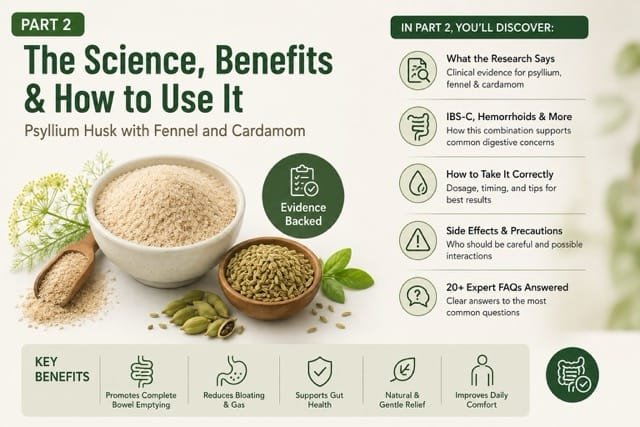
In Part 2, we’ll explore the clinical evidence behind this combination, discuss how it may benefit people with IBS-C and hemorrhoids, explain proper dosing and timing, review safety considerations and drug interactions, answer the most frequently asked questions, and provide a comprehensive list of scientific references suitable for a medical website.