
 Dr. Ahmed Farhan
Author & Medical Reviewer: Dr. Ahmed Farhan | Published: October 2026 | Last Clinically Reviewed: October 2026
Categories: Diabetes Medications | Diabesity & Obesity
The medical management of obesity and cardiometabolic disease has evolved rapidly. While semaglutide (Wegovy) and tirzepatide (Zepbound) serve as established, FDA-approved medications for chronic weight management, a third candidate—retatrutide—has drawn substantial interest after clinical trials reported average weight losses reaching 25% to 28%.
However, evaluating these therapies requires looking beyond headline percentages. Clinical trials differed in length, enrolled diverse populations, and calculated weight loss using different statistical frameworks. Critically, while semaglutide and tirzepatide are approved and strictly regulated, retatrutide remains an unapproved investigational compound that cannot legally be prescribed.
Table of Contents
- 1. Mechanisms of Action: Single vs. Dual vs. Triple Agonism
- 2. Clinical Trial Comparison: Efficacy Overview
- 3. Detailed Examination of Pivotal Studies
- 4. Why Cross-Trial Comparisons Can Be Misleading
- 5. Safety, Tolerability, and Side Effects
- 6. Unregulated “Research Peptides”: Health and Safety Warnings
- 7. Long-Term Considerations: What Happens After Discontinuation?
- 8. Summary of Evidence: Established Facts vs. Gaps
- 9. Frequently Asked Questions
- 10. References & Clinical Data Sources
1. Mechanisms of Action: Single vs. Dual vs. Triple Agonism
All three therapeutics mimic endogenous gastrointestinal hormones that regulate appetite, digestive transit, and insulin secretion. However, they engage distinct molecular pathways:
Semaglutide: Selective GLP-1 Agonist
Semaglutide selectively stimulates the glucagon-like peptide-1 (GLP-1) receptor. By activating central pathways in the brainstem and hypothalamus, it suppresses appetite, slows gastric motility, and promotes glucose-dependent insulin secretion.
Tirzepatide: Dual GLP-1 and GIP Agonist
Tirzepatide co-activates receptors for both GLP-1 and glucose-dependent insulinotropic polypeptide (GIP). GIP signaling enhances insulin release, modulates fat tissue metabolism, and may improve gastrointestinal tolerability. The combined activity produces synergistic metabolic control and greater average weight loss than GLP-1 stimulation alone.
Retatrutide: Investigational Triple Agonist (GLP-1, GIP, and Glucagon)
Retatrutide introduces agonism at the glucagon receptor alongside GLP-1 and GIP pathways. Glucagon stimulates hepatic energy expenditure and lipid clearance. While glucagon on its own elevates blood sugar during fasting, simultaneous activation of GLP-1 and GIP pathways preserves glycemic control while promoting sustained energy expenditure. The extent of this metabolic acceleration in human clinical settings remains under active study.
2. Clinical Trial Comparison: Efficacy Overview
The table below summarizes clinical trial results from the main phase 3 trials for the highest studied doses in adults with obesity or overweight without type 2 diabetes:
| Trial Characteristic | Semaglutide 2.4 mg | Tirzepatide 15 mg | Retatrutide 12 mg |
|---|---|---|---|
| Brand Name | Wegovy (Ozempic for T2D) | Zepbound (Mounjaro for T2D) | None (Investigational) |
| Receptor Profile | GLP-1 (Single) | GLP-1 + GIP (Dual) | GLP-1 + GIP + Glucagon (Triple) |
| Regulatory Status | FDA-Approved | FDA-Approved (Nov 2023) | Unapproved (Phase 3 ongoing) |
| Registration Trial | STEP 1 | SURMOUNT-1 | TRIUMPH-1 |
| Treatment Length | 68 Weeks | 72 Weeks | 80 Weeks |
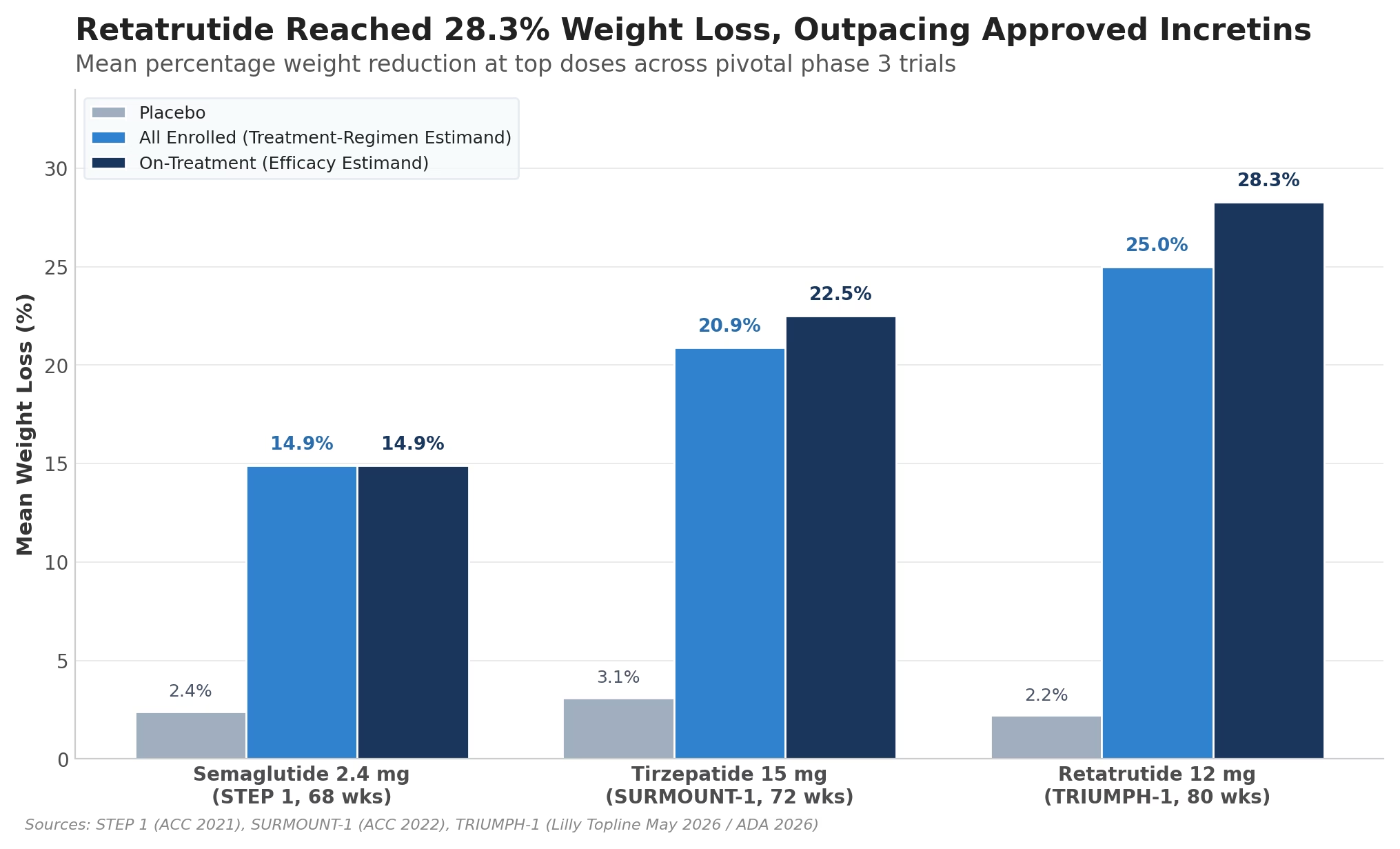
| Efficacy Estimand (On-Treatment) | 14.9% vs. 2.4% placebo | 22.5% vs. 3.1% placebo | 28.3% vs. 2.2% placebo |
| Treatment-Regimen Estimand (ITT) | 14.9% | 20.9% | 25.0% (~70 lbs lost) |
| Direct Head-to-Head Evidence | 13.7% in SURMOUNT-5 | 20.2% in SURMOUNT-5 | No completed direct head-to-head trials |
| Evidence Quality | Established (Phase 3 peer-reviewed) | Established (Phase 3 peer-reviewed) | Emerging (Topline & abstracts) |
3. Detailed Examination of Pivotal Studies
Semaglutide: The STEP 1 Benchmark
In the STEP 1 trial involving 1,961 adults without type 2 diabetes, participants treated with once-weekly subcutaneous semaglutide 2.4 mg alongside lifestyle changes achieved a mean weight reduction of 14.9% at 68 weeks, compared to 2.4% in the placebo group. Adverse events were predominantly mild-to-moderate gastrointestinal symptoms, with 4.5% discontinuing treatment due to adverse events.
Tirzepatide: Head-to-Head Superiority (SURMOUNT-1 & SURMOUNT-5)
In SURMOUNT-1 (2,539 participants without diabetes), tirzepatide 15 mg produced a mean weight reduction of 20.9% across all enrolled participants (22.5% on-treatment) over 72 weeks.
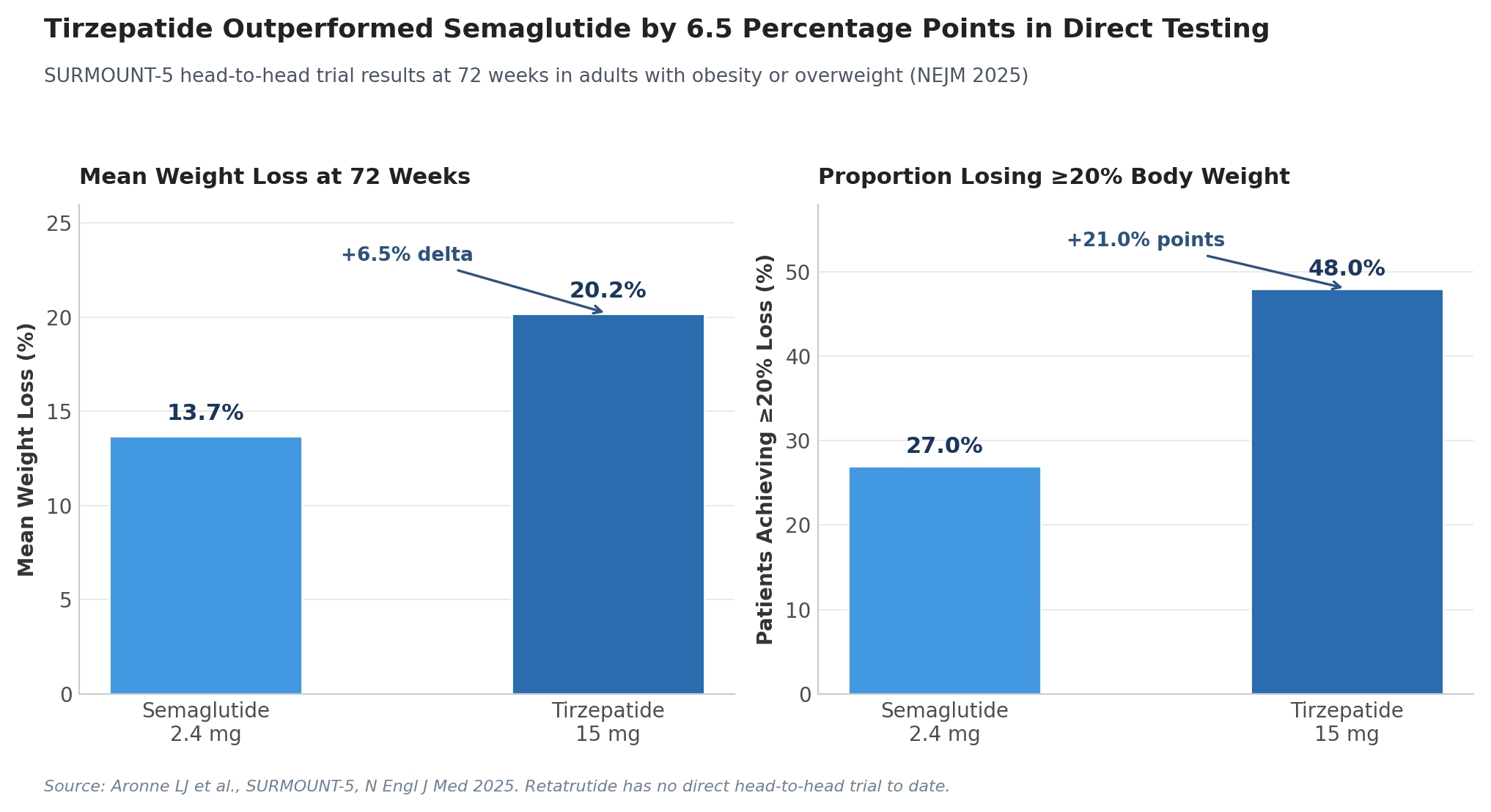
Direct comparative evidence arrived with the SURMOUNT-5 trial, published in the New England Journal of Medicine. In this 72-week head-to-head study, patients randomized to tirzepatide achieved a mean weight loss of 20.2% versus 13.7% for semaglutide. Furthermore, 48% of tirzepatide-treated participants achieved at least 20% weight reduction compared with 27% on semaglutide.
Retatrutide: The TRIUMPH Clinical Program
Following a 48-week phase 2 study where patients lost up to 24.2% of body weight, retatrutide entered the global phase 3 TRIUMPH program:
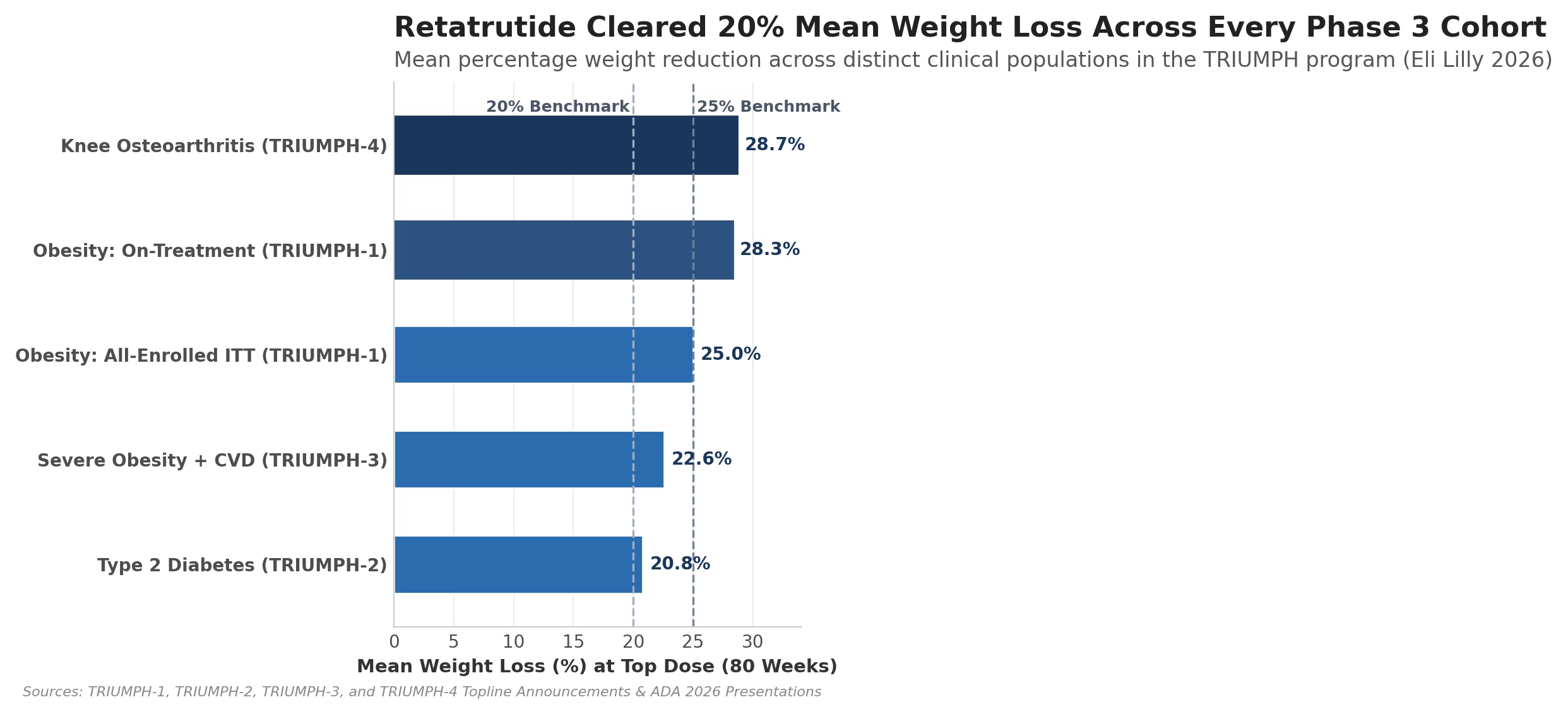
- TRIUMPH-1 (Obesity without Diabetes): In 2,339 adults over 80 weeks, dose tiers achieved 19.0%, 25.9%, and 28.3% weight loss under the on-treatment efficacy estimand. Across all enrolled participants, the 12 mg dose yielded an average loss of 25.0% (approximately 70 lbs), with 62% losing at least 25% of their starting weight.
- TRIUMPH-2 & TRIUMPH-3 (Type 2 Diabetes & Cardiovascular Disease): In patients with type 2 diabetes, retatrutide produced weight reductions of up to 20.8% and reduced HbA1c by up to 1.6 percentage points (explore our update on new type 2 diabetes guidelines). In individuals with cardiovascular disease and severe obesity, weight reduction reached 22.6%.
- TRIUMPH-4 (Knee Osteoarthritis): Participants experienced up to 28.7% weight loss and an approximate 75% reduction in pain scores.
4. Why Cross-Trial Comparisons Can Be Misleading
Placing 14.9%, 20.9%, and 28.3% in a simple ranking overlooks critical methodology differences:
- Different Durations: STEP 1 ran for 68 weeks, SURMOUNT-1 for 72 weeks, and TRIUMPH-1 for 80 weeks. Because weight loss with incretin therapies accumulates gradually before plateauing, longer trial durations allow more time for weight reduction.
- Baseline Patient Adiposity: Participants in TRIUMPH-1 had a higher mean baseline BMI (~40 kg/m²) than those in STEP 1 or SURMOUNT-1 (~38 kg/m²). Weight-loss percentages can be influenced by starting mass.
- Statistical Estimands: The efficacy estimand (on-treatment) counts outcomes only among patients who completed therapy as planned, whereas the treatment-regimen estimand (intention-to-treat) includes all participants regardless of adherence or discontinuation. Comparing retatrutide’s on-treatment figure (28.3%) with tirzepatide’s intention-to-treat figure (20.9%) inflates the difference. Comparing both on intention-to-treat data (25.0% vs. 20.9%) reveals a narrower gap of roughly 4.1 percentage points.
5. Safety, Tolerability, and Side Effects
Effective weight management therapies must balance efficacy against patient safety and daily tolerability:
Gastrointestinal Effects
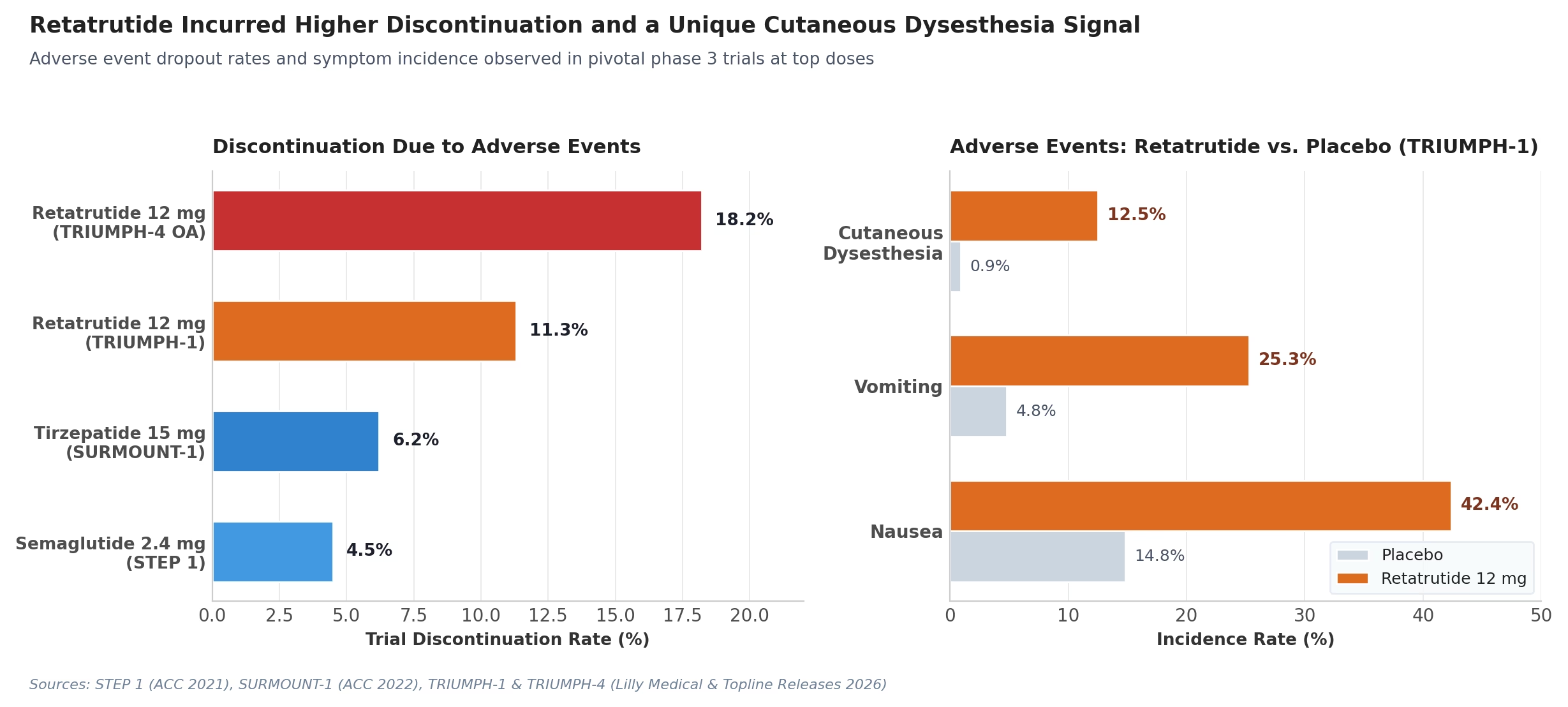
Nausea, diarrhea, vomiting, and constipation are common across this drug class due to delayed gastric emptying. In TRIUMPH-1, 42.4% of patients receiving 12 mg retatrutide experienced nausea (vs. 14.8% on placebo) and 25.3% reported vomiting (vs. 4.8% on placebo). For non-pharmacological relief strategies, see our clinical guides on handling sulfur burps and managing incretin-induced constipation.
Discontinuation Rates
The rate of study withdrawal due to adverse events reflects overall tolerability:
- Semaglutide 2.4 mg (STEP 1): 4.5%
- Tirzepatide 15 mg (SURMOUNT-1): 6.2% (vs. 2.6% placebo)
- Retatrutide 12 mg (TRIUMPH-1): 11.3% (vs. 4.9% placebo)
- Retatrutide 12 mg (TRIUMPH-4): 18.2% (vs. 4.0% placebo)
Cutaneous Dysesthesia
A notable adverse effect observed in retatrutide trials is cutaneous dysesthesia—abnormal sensations on the skin, including sensitivity, prickling, or burning. It occurred in 12.5% of patients on 12 mg retatrutide in TRIUMPH-1 (vs. 0.9% on placebo) and in 20.9% of patients in TRIUMPH-4. Symptoms were primarily mild to moderate and generally did not prompt discontinuation, but the symptom profile warrants medical monitoring.
Cardiovascular Observations & Boxed Warnings
In phase 2 studies, retatrutide was associated with a transient rise in resting heart rate that peaked around week 24 before declining. Dedicated cardiovascular outcome data remain indeterminate. Like semaglutide and tirzepatide, multi-agonist trials adhere to precautions regarding medullary thyroid carcinoma risks identified in animal models, excluding individuals with personal or familial histories of medullary thyroid cancer or MEN 2.
6. Unregulated “Research Peptides”: Health and Safety Warnings
Widespread interest in retatrutide has driven an illicit online market where non-pharmaceutical vendors sell unapproved vials labeled “for research use only” or “not for human consumption.”
The health risks associated with purchasing and self-injecting these compounds are severe:
- FDA Regulatory Action: The FDA has issued at least 14 warning letters to online vendors marketing unapproved retatrutide since late 2024.
- Spike in Adverse Events: FDA adverse event reports concerning illicit retatrutide increased from 10 cases in 2025 to 26 in the first five months of 2026 alone.
- Chemical Quality Testing: Analytical firm Finnrick tested 179 vendor samples and rated 71 vendors (roughly 40%) as poor, bad, or fraudulent. Serious problems included severe dosing inaccuracies, chemical contaminants, and lack of sterile processing.
- Consumer Alerts: Public Citizen and the National Consumers League have published urgent warnings cautioning patients against using unverified online peptides.
Clinical Recommendation: Do not purchase injectable peptides from unregulated suppliers. Injecting non-sterile, unverified formulations carries life-threatening risks of severe infection, toxic contamination, and overdose.
7. Long-Term Considerations: What Happens After Discontinuation?
Obesity is a chronic, relapsing metabolic disease rather than a short-term condition. When incretin and multi-agonist medications are discontinued, appetite signals and metabolic rates typically revert to baseline levels.
In the off-treatment extension of the STEP 1 trial, participants who discontinued semaglutide regained approximately two-thirds of their lost body weight within one year. Furthermore, earlier improvements in blood pressure, glycemic markers, and lipid parameters largely reversed. For an in-depth clinical analysis, read our review on weight regain following GLP-1 cessation.
8. Summary of Evidence: Established Facts vs. Gaps
What the Evidence Confirms
- Semaglutide and tirzepatide are FDA-approved, thoroughly documented options for chronic weight management.
- Tirzepatide demonstrated superior weight loss compared to semaglutide in direct head-to-head testing (20.2% vs. 13.7% in SURMOUNT-5).
- Retatrutide generated the highest average weight loss in phase 3 trials (25.0% all-enrolled; 28.3% on-treatment).
- Gastrointestinal adverse effects are common to all three agents; retatrutide introduces a distinct cutaneous dysesthesia signal.
- Retatrutide remains an investigational drug. An FDA application is planned for early 2027.
Current Evidence Gaps
- Long-term human safety beyond 80 weeks remains unestablished for retatrutide.
- Cardiovascular outcomes trials for retatrutide have not established definitive cardiovascular benefit.
- Detailed human body composition data regarding lean mass preservation need broader publication.
- Post-treatment weight regain patterns for retatrutide have not been fully documented in formal extension studies.
- No direct head-to-head trial comparing retatrutide against tirzepatide has been conducted.
9. Frequently Asked Questions
Is retatrutide approved by the FDA?
No. Retatrutide is an investigational drug currently in phase 3 clinical trials. Eli Lilly plans to submit a New Drug Application in early 2027, but approval is subject to regulatory review.
Which drug produces the greatest weight loss?
In clinical trials, retatrutide produced the highest average weight reduction (up to 28.3% on-treatment). Among FDA-approved options, tirzepatide demonstrated greater weight reduction than semaglutide in head-to-head testing (20.2% vs. 13.7%).
Does a 28% weight loss result apply to every patient?
No. Clinical trial figures represent cohort averages. In TRIUMPH-1, approximately 62% of participants on the highest dose lost at least 25% of their starting body weight, while 38% lost less, demonstrating individual variation in treatment response.
What is cutaneous dysesthesia?
Dysesthesia refers to abnormal or heightened skin sensitivity, often described as tingling, prickling, or tenderness. In retatrutide trials, it occurred in 12.5% to 20.9% of participants on high doses. Most cases were mild to moderate.
Is it safe to purchase research retatrutide online?
No. Medical and consumer protection agencies advise against self-injecting unapproved online peptides. Testing reveals widespread issues with incorrect dosing, chemical impurities, and missing sterility controls.
10. References & Clinical Data Sources
- Eli Lilly and Company. TRIUMPH-1 Topline Results: Lilly’s Triple Agonist Retatrutide Delivered Powerful Weight Loss. Investor Relations, May 21, 2026.
- Aronne LJ, et al. Tirzepatide as Compared with Semaglutide for the Treatment of Obesity (SURMOUNT-5). New England Journal of Medicine, 2025.
- Jastreboff AM, et al. Triple-Hormone-Receptor Agonist Retatrutide for Obesity: A Phase 2 Trial. New England Journal of Medicine, 2023; 389:514-526.
- Wilding JPH, et al. Weight Regain and Cardiometabolic Effects After Withdrawal of Semaglutide: The STEP 1 Trial Extension. Diabetes, Obesity and Metabolism, 2022; 24(8):1553-1564.
- American College of Cardiology. Semaglutide Treatment Effect in People with Obesity (STEP 1 Trial). ACC Clinical Trial Repository, 2021.
- American College of Cardiology. Tirzepatide Once Weekly for the Treatment of Obesity (SURMOUNT-1). ACC Clinical Trial Repository, 2022.
- American Diabetes Association (ADA). TRIUMPH-1 Phase 3 Retatrutide Data. 86th Scientific Sessions, June 2026.
- HCPLive. Retatrutide Meets Phase 3 Weight Loss Endpoints in Two Obesity Trials (TRIUMPH-2 and TRIUMPH-3). July 23, 2026.
- Eli Lilly Medical. Was Dysesthesia Reported as an Adverse Event in the Retatrutide TRIUMPH Clinical Trials? Medical Information Documentation.
- US Food and Drug Administration (FDA). Zepbound (Tirzepatide) Prescribing Information & Boxed Warnings. Reference ID 217806.
- Public Citizen. Retatrutide Investigation: The Proliferation of Unapproved Injectable Peptides Online. Health Research Group Report, June 16, 2026.
- National Consumers League (NCL). Consumer Warning Regarding Self-Injecting Research-Grade Peptides. July 24, 2026.
About the Author & Medical Reviewer
Dr. Ahmed Farhan is a practicing physician, clinical researcher, and Editor-in-Chief of Dibesity.com. He writes extensively on diabetes care, obesity pharmacotherapy, and cardiometabolic medicine, translating clinical trial evidence into patient guidance. Discover more on his contributor profile.
Editorial Independence: Dibesity.com does not accept pharmaceutical sponsorships for clinical drug comparisons. Academic research submissions can be directed to the Journal of Diabesity.
Recommended Products & Affiliate Disclosure
The products listed below are selected from our range of health, wellness, and lifestyle products that readers may find useful. Some links are affiliate links, which means Dibesity.com may earn a commission if you make a purchase through them, at no additional cost to you.
Editorial independence: Our educational and medical content is developed with an emphasis on evidence-based information and reader education. The inclusion of a product in this section does not constitute a medical recommendation, a guarantee of effectiveness, or an endorsement of any health claim. Product descriptions and prices may change, so please check the retailer’s listing for the latest details.
Amazon Associate Disclosure: As an Amazon Associate, Dibesity.com earns from qualifying purchases.
Apigenin Powder
Explore this apigenin powder option and review its ingredients, product details, and customer feedback.
$35.90
View on AmazonBerberine Powder — 200 g
Review the product listing for ingredient information, serving details, and available customer reviews.
$41.90
View on AmazonStrawberry Allulose Gummies
Strawberry-flavored allulose gummies. Visit the listing for product ingredients and package details.
$14.90
View on AmazonPsyllium Husk with Fennel & Cardamom
A psyllium husk blend featuring fennel and cardamom. Check the listing for ingredients and serving information.
$18.90
View on Amazon97% Pure Berberine Powder — 100 g
Berberine powder with a stated purity of 97%. See the product listing for further details.
$25.90
View on Amazon100% Pure Hibiscus Powder
Hibiscus powder for your pantry. Review the listing for ingredient, sourcing, and preparation information.
$14.90
View on AmazonWatermelon Allulose Gummies
Watermelon-flavored allulose gummies. Check the listing for ingredients, package size, and product details.
$14.90
View on AmazonMixed Berry Allulose Gummies
Mixed berry-flavored allulose gummies. Visit the listing for ingredients and available package information.
$16.90
View on AmazonAffiliate Disclosure: As an Amazon Associate, Dibesity.com earns from qualifying purchases. Product prices and availability may change; please check Amazon for the latest information.